Slot Machines Wearing a Football Jersey: The Hidden Casino Math Inside Your Same-Game Parlay
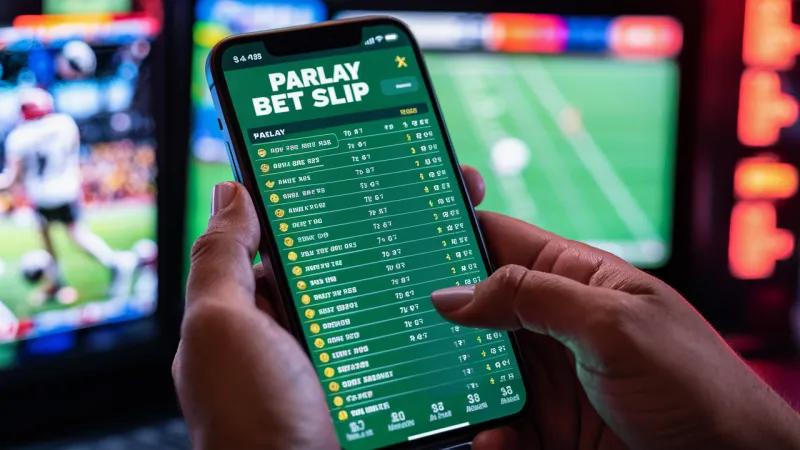
Photo: smartphone sports betting app parlay screen close-up, via allthepicks.com
There's a moment every sports bettor in America knows. It's the fourth quarter, your six-leg same-game parlay needs one more touchdown, and you're pacing the kitchen like it's a Super Bowl–winning field goal. Your heart rate says football. Your wallet, unfortunately, is playing a different game entirely.
Here's the uncomfortable truth: when you stack props into an SGP, you've left the sportsbook floor and quietly walked into the casino. The math says so. The psychology says so. And once you learn to spot the difference, you'll never look at a "Mahomes over 2.5 TDs + Kelce anytime scorer + over 48.5 points" ticket the same way again.
The Hold You Don't See
Every bet at a US sportsbook carries a built-in margin — the hold, or vig. A standard spread bet at -110 runs about 4.5% hold. That's the price of admission, and sharp bettors treat it like rent: unavoidable, but known.
Now stack five legs. Each leg carries its own margin, and they multiply. A five-leg SGP built from -110 markets can carry a hold north of 20%. That's not a spread bet anymore. That's a penny slot at a Vegas airport — which typically runs 10-15% hold — except the slot machine at least tells you it's a slot machine.
Same-game parlays hide the number. The app shows you a juicy payout multiplier and a fun little combo builder. It does not show you that you just agreed to fight a house edge two to four times steeper than the games your Uncle Ray loses his rent money on in Reno.
Correlation Pricing: The Book's Secret Weapon
Why are SGPs so much more profitable for sportsbooks than old-school parlays? One word: correlation.
In a traditional parlay, each leg is an independent event. The Bears covering and the Over hitting in a Cardinals game? Unrelated. The book prices each leg's margin separately, and they compound honestly.
Inside a single game, though, legs are tangled together. QB passing yards, his receiver's receiving yards, and the game total all move together. If you could price that correlation yourself and bet it at fair value, correlated parlays could be gold mines. The sportsbooks know this — which is exactly why they don't offer fair pricing.
When you build an SGP in the app, the odds on each leg quietly shrink. That +150 anytime scorer might be +135 in a parlay context. The QB yardage line that's -110 straight gets shaded inside the combo. The book's pricing engine eats your correlation before you ever see it, and the payout you're offered reflects a margin so thick it would make a casino floor manager blush.
The result: SGPs became the fastest-growing, highest-hold product in American sports betting. Industry filings have shown same-game parlay holds in the 20-30% range for major operators — versus low single digits for straight bets. You're not betting sports. You're feeding a machine.
The Psychology of One More Leg
Slot machines are engineered around a simple loop: small anticipation, near-misses, and a payout cadence that keeps you pulling. SGPs replicate this with startling precision.
- The near-miss. Four of five legs hit. You didn't lose — you "almost won." Psychologically, that's fuel for the next ticket, not a reason to stop. Slots do the same thing by landing two jackpot symbols and a cherry.
- The quick cycle. SGPs resolve within hours. Slots spin in seconds. Fast feedback loops are the backbone of every high-frequency gambling product ever built.
- The illusion of skill. Building a parlay feels like handicapping. You researched the matchup, you found the stack, you made a decision. That sensation of agency is exactly what makes the steeper hold tolerable — you never feel the margin because you feel the competence.
- The chase. One more leg turns a 4x payout into a 9x payout. The marginal leg adds the most hold and the least win probability, but it feels like leverage. It's leverage for the house.
If you behave like a slot player — chasing near-misses, adding legs for dopamine, betting fast and often — the SGP will happily treat you like one.
Slot Machines in Disguise: A Field Guide
Not every parlay is a trap. Some are just expensive. Here's the practical framework we use to sort real bets from dressed-up house games.
1. Calculate the no-vig price before you build. Strip the juice from each leg's market (convert the odds to implied probabilities, remove the overround) and multiply the fair probabilities together. Compare that to the parlay payout you're offered. If the gap exceeds roughly 5%, you're paying slot-machine rent.
2. Watch for shaded legs. Compare each leg's price inside the SGP builder to its standalone price. If the builder silently drops every leg by 10-20 cents, the book is taxing your correlation twice — once in the hold, once in the shade. Walk away.
3. Beware props with wide pricing uncertainty. Player props — catches, receiving yards, assists — are the softest lines in the book if you have an edge in projecting them, but they're also where books hide their fattest margins. A prop priced at -115 both ways with a big gap to the market consensus isn't a soft line. It's a toll booth.
4. Favor legs with genuine positive correlation you can articulate. A game total paired with a QB passing touchdown prop is coherent — the events are linked and you can explain why. Randomly stacking a rebound prop with a first-period goal? That's not correlation, that's a lottery ticket in a jersey.
5. Count your legs honestly. Every leg beyond three multiplies the hold faster than the payout grows. If your ticket needs five legs to feel exciting, the excitement is the product. The house edge is the price.
Play It Like a Fan or Play It Like a Sharp — Just Know Which You Are
Look, there's nothing wrong with throwing a fun SGP on Sunday afternoon with twenty bucks you'd otherwise spend on wings. It's entertainment, and entertainment has a price. The problem starts when prop-heavy bettors treat high-hold parlays like an investment strategy — betting them daily, chasing the near-misses, adding "just one more leg."
That behavior isn't sports betting. It's slot play with better graphics and a Tom Brady cameo in the ad. The sportsbooks figured out that the most profitable gambler isn't the sharp grinding closing line value — it's the fan who bets like a casino customer while believing they're a football expert.
Know the hold. Price the correlation. Count the legs. And when the app hands you a near-miss and a nudge toward one more ticket, remember what that voice is: not a commentator, not a handicapper — a slot machine asking for one more pull.
Your bankroll will thank you by surviving February.